

From Local Innovation to European Impact: New GEMINI Research Explores How Smart Mobility Solutions Can Be Replicated Across Cities
What makes a smart mobility solution successful in one city, and what does it take to implement it elsewhere? A new scientific publication developed within the GEMINI project explores this challenge, offering practical insights into interoperability, governance and the transferability of innovative mobility services across Europe.
Published on 5 September 2026 in the peer-reviewed journal Smart Cities, the paper, “An Exploratory Study of the Transferability of Smart Mobility Solutions Across Seven European Mobility Living Labs: Towards an Interoperability and Governance Framework”, was authored by Shaghayegh Rahnama, David Escuin, David Cipres and Lorena Polo from ITA – Instituto Tecnológico de Aragón, a GEMINI project partner.
The research draws on experiences from seven European urban contexts involved in GEMINI: Amsterdam, Copenhagen, Helsinki, Munich, Paris-Saclay, Porto and Turin. Its objective is to understand why innovative mobility solutions can be difficult to transfer between cities and identify the conditions that make their wider adoption possible.
Why is transferring smart mobility solutions so challenging?
Across Europe, cities are experimenting with Mobility-as-a-Service (MaaS), shared mobility platforms, multimodal journey planners and other digital transport solutions. These innovations offer opportunities to improve accessibility, integrate transport services and support more sustainable travel.
However, a solution that works effectively in one city cannot necessarily be implemented in another without significant adaptation.
The study highlights that the main obstacles are not exclusively technological. Differences in local regulations, governance structures, data-sharing arrangements and existing transport infrastructure can make it difficult to replicate even technically advanced solutions.
For example, a mobility application may rely on data formats or payment systems that are not available in another city. Similarly, differences in cooperation between public authorities and private operators can create barriers to integration.
Understanding these conditions is essential to help cities build on existing innovations rather than repeatedly developing solutions from scratch.
Learning from seven European mobility contexts
The researchers examined 12 smart mobility applications associated with the seven GEMINI urban contexts, covering MaaS platforms, public transport journey planners, car-sharing services, shared micromobility and mobility data tools.
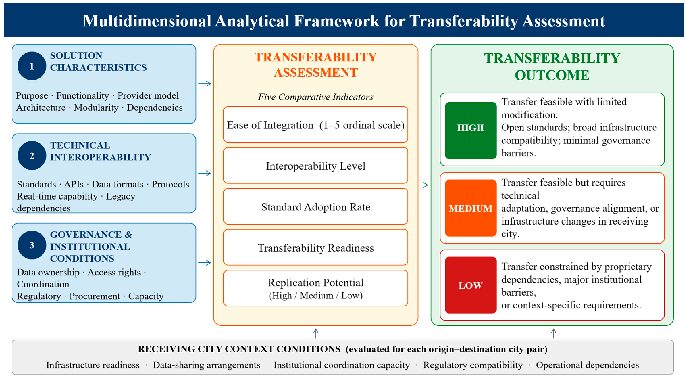
The applications were assessed through a framework combining technical and organisational factors, including ease of integration, interoperability, adoption of common standards and replication potential.
The comparative analysis offers several important insights.
Open standards and modular architectures facilitate replication. Applications using well-documented interfaces and recognised data standards, such as GTFS and GBFS, generally demonstrated greater potential for integration into different mobility ecosystems.
Governance matters as much as technology. Clear data-sharing agreements, effective coordination between public and private stakeholders, and appropriate institutional arrangements are essential for transferring solutions successfully.
Existing infrastructure can be a major obstacle. Legacy ticketing systems, proprietary platforms and incompatible data formats often require additional investment and technical adaptation.
Replication does not necessarily mean copying a solution unchanged. Successful transfer may require adapting an application’s technical configuration, operational arrangements and governance model to the needs of the receiving city.
These findings reinforce one of GEMINI’s central messages: mobility innovation must be designed with local conditions in mind, while creating opportunities for knowledge sharing and wider adoption.
Turning research into practice: The GEMINI Knowledge Hub
An important contribution of the study is the development of the GEMINI Knowledge Hub, a publicly accessible platform designed to support knowledge exchange and informed decision-making.
Launched in May 2026, the platform brings together information on mobility applications, technical standards, implementation challenges and experiences from the participating Mobility Living Labs.
Through five interconnected modules — MLL Solutions, Applications, Knowledge Library, Standards, and Challenges and Needs — users can explore solutions implemented in different cities, understand their technical characteristics and identify potential barriers to adoption.
The Knowledge Hub is not limited to GEMINI partners. Cities, transport authorities, researchers and mobility organisations across Europe can access the platform and contribute information about their own solutions.
By transforming project experiences into structured and accessible knowledge, the Hub aims to help other cities identify relevant innovations and assess what would be required to adapt them to their own mobility ecosystems.
Explore the GEMINI Knowledge Hub: https://geminiknowledgehub.eu/
Supporting the future of sustainable urban mobility
The publication provides valuable guidance for policymakers, mobility operators and technology providers seeking to move beyond isolated pilot projects.
Its findings underline the importance of promoting open data standards, modernising existing transport infrastructure, strengthening cooperation between stakeholders and integrating knowledge-sharing tools into mobility planning.
The research also highlights the need for further validation of the proposed framework through actual cross-city implementation experiences. While the assessment identifies promising conditions for replication, future research will be important to determine how these translate into successful deployments.
For GEMINI, this publication represents another step towards ensuring that the knowledge generated through its Mobility Living Labs can support innovation beyond the project’s original locations.
By connecting technical interoperability with governance and institutional readiness, the study offers a practical foundation for helping European cities learn from one another and develop more integrated, accessible and sustainable mobility systems.
Read the full publication
Title: An Exploratory Study of the Transferability of Smart Mobility Solutions Across Seven European Mobility Living Labs: Towards an Interoperability and Governance Framework
Authors: Shaghayegh Rahnama, David Escuin, David Cipres and Lorena Polo (ITA – Instituto Tecnológico de Aragón)
Journal: Smart Cities, 2026, Volume 9, Article 145
Publication date: 5 September 2026
Full paper (Open Access): https://doi.org/10.3390/smartcities9090145