

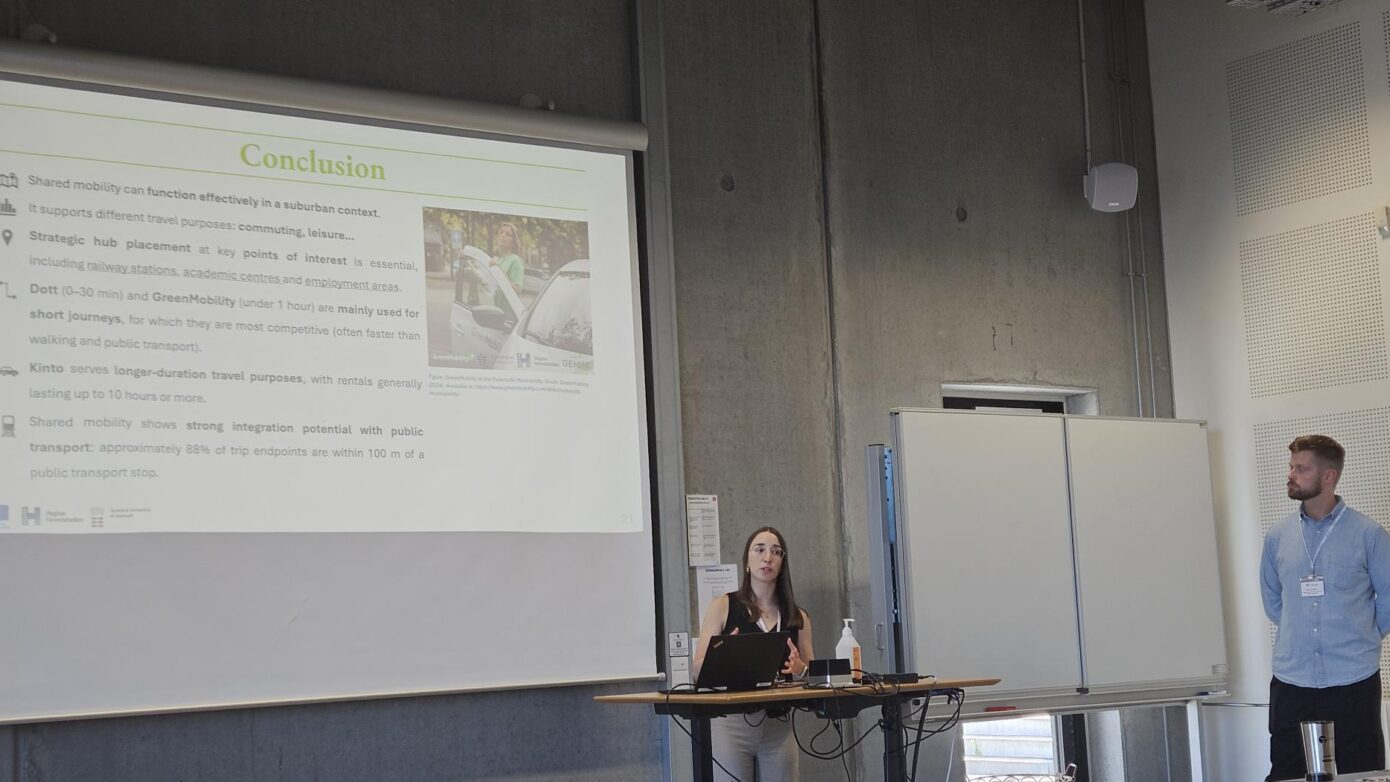
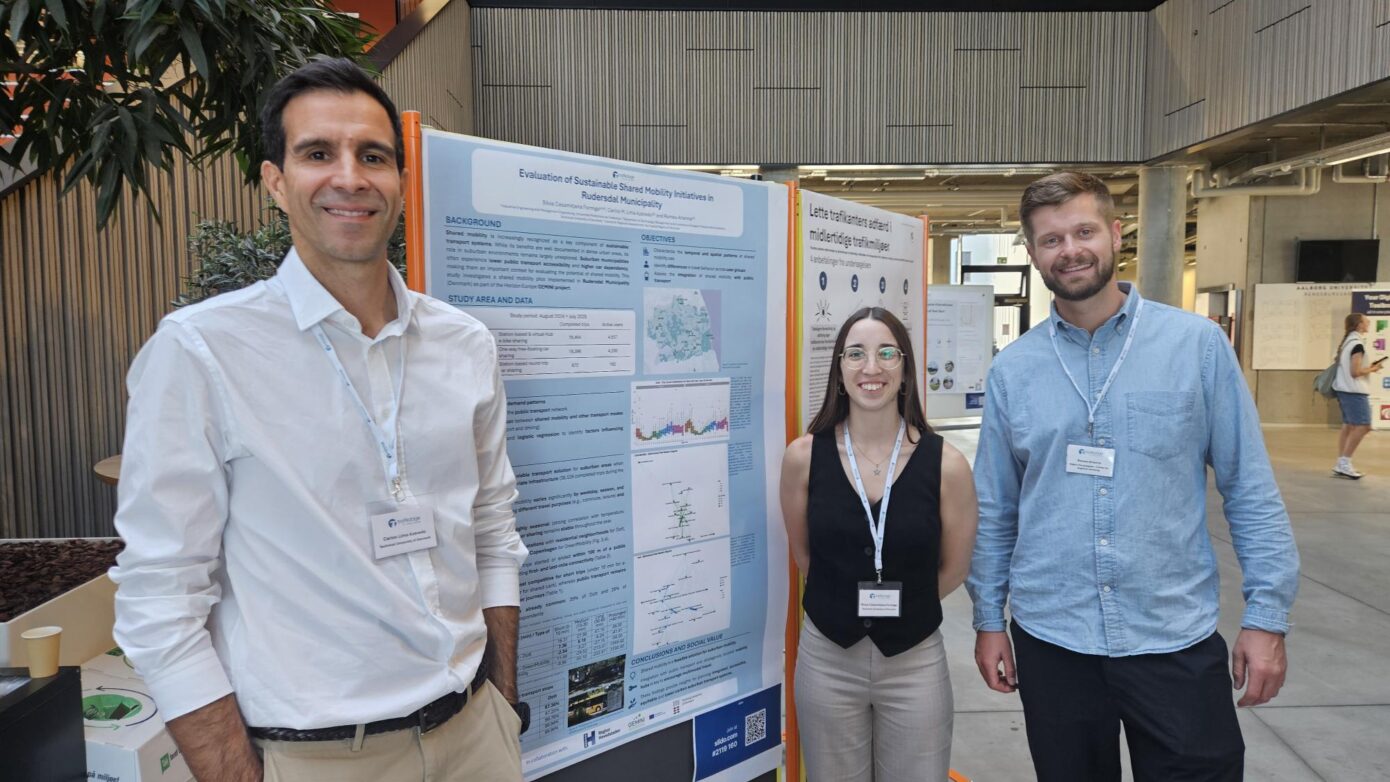
The GEMINI project was recently represented at the Annual Transport Conference at Aalborg University, 24 to 26 August 2026, where results from the Rudersdal Mobility Living Lab were presented through the study “Evaluation of Sustainable Shared Mobility Initiatives in Rudersdal Municipality.” The work was presented by Sílvia Casamitjana Formiga, former master’s student at DTU, together with Romèo Arianna from the Capital Region of Denmark.
The study was developed as part of the final evaluation of GEMINI’s activities on shared mobility and mobility hubs in Rudersdal, in collaboration with Carlos M. Lima Azevedo from DTU Management. Between September 2025 and January 2026, Sílvia analysed operational trip data from Dott, GreenMobility and KINTO, looking at temporal and spatial mobility patterns and at the relationship between shared mobility and public transport.
Understanding shared mobility in a suburban context
While shared mobility has already been widely studied in dense urban environments, its role in suburban areas is still less understood. This is particularly relevant in municipalities where public transport accessibility can be lower and dependence on private cars higher.
The study therefore examined the shared mobility pilot implemented in Rudersdal Municipality, Denmark, as part of the Horizon Europe GEMINI project, with three main objectives: understanding when and where shared mobility is used, identifying differences in travel behaviour among different user groups, and assessing how shared mobility integrates with public transport.
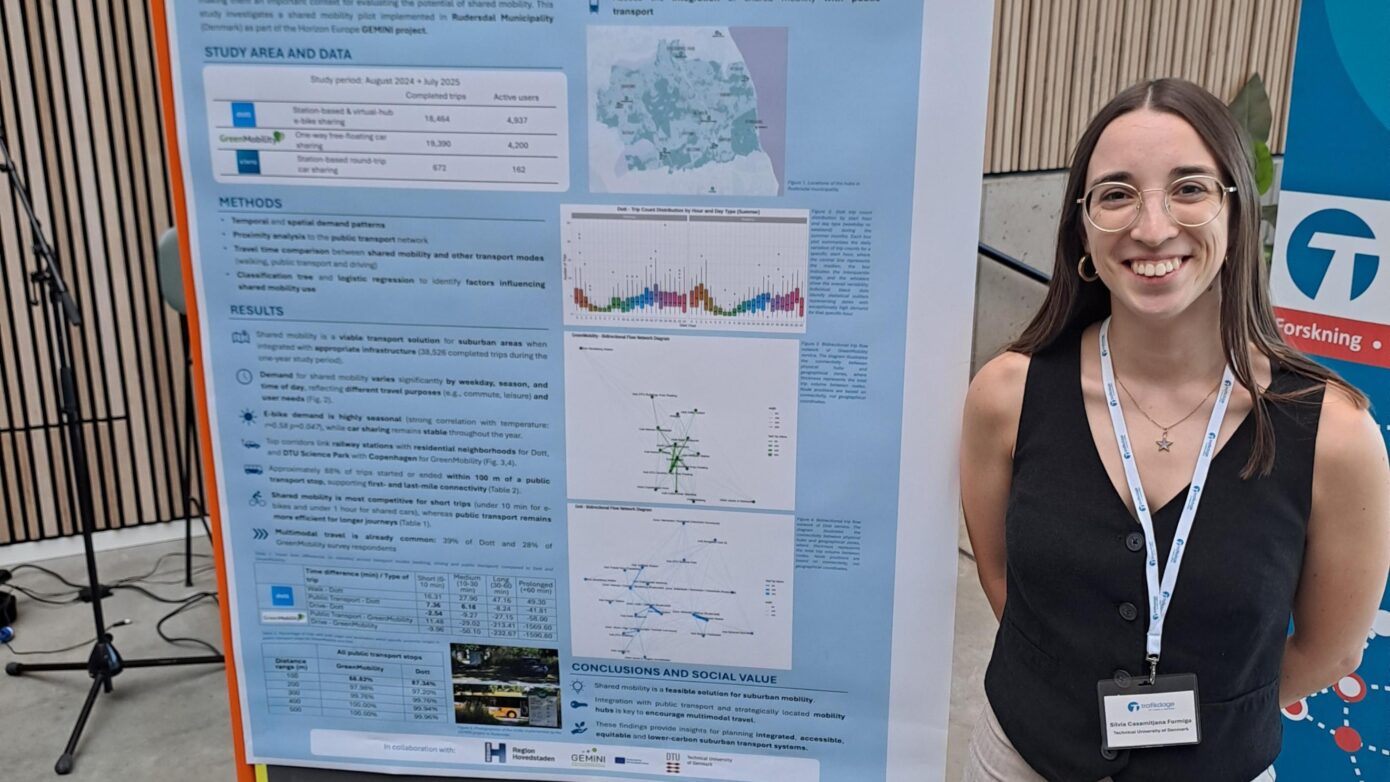
The analysis covered mobility activity from August 2024 to July 2025 and included e-bike sharing, one-way free-floating car sharing and station-based round-trip car sharing. Altogether, the services generated 38,526 completed trips during the one-year study period.
Key findings from the Rudersdal Mobility Living Lab
The results provide encouraging evidence about the potential of shared mobility outside major city centres.
Demand patterns differed significantly depending on the day of the week, season and time of day, reflecting the different purposes for which users relied on the services. E-bike demand showed a particularly strong seasonal component, while car-sharing demand remained more stable throughout the year.
The study also highlighted the importance of integration with public transport. Around 88% of shared mobility trips started or ended within 100 metres of a public transport stop, showing the potential of these services to support first- and last-mile connections. Shared mobility proved particularly competitive for shorter journeys, while public transport remained more efficient for longer trips.
Overall, the findings indicate that shared mobility can be a viable solution for suburban areas, especially when supported by appropriate infrastructure and strategically located mobility hubs. Integration with public transport emerges as a key factor in encouraging multimodal travel and developing more accessible, equitable and lower-carbon suburban transport systems.
Recognition for outstanding research
The event also brought an important recognition for the work carried out within the GEMINI context. Sílvia presented a poster summarising the study and was awarded the Traffic Days Student Award at the Annual Transport Conference at Aalborg University for her outstanding work.
The award represents a valuable acknowledgement of the research developed around the Rudersdal Mobility Living Lab and of GEMINI’s broader contribution to generating evidence on how shared mobility solutions can support the transition towards more sustainable transport systems beyond dense urban areas.