

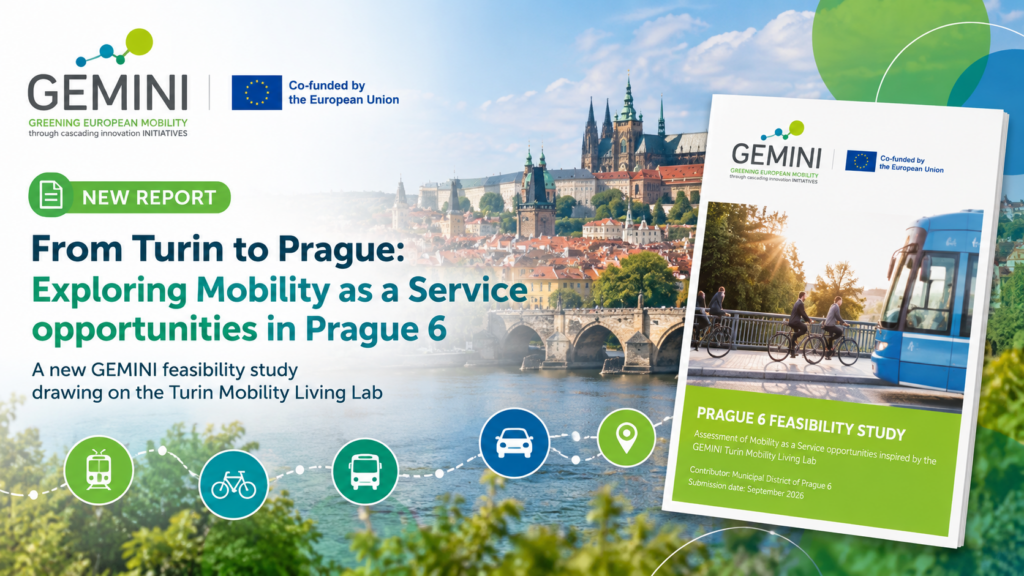
From Turin to Prague: GEMINI publishes a new feasibility study on Mobility as a Service
How can innovative mobility solutions developed in one European city inspire sustainable transport improvements in another?
The GEMINI project has published a new feasibility study exploring the potential introduction of Mobility as a Service (MaaS) in Prague 6, drawing on the experience and results of the GEMINI Turin Mobility Living Lab.
Prepared by the Municipal District of Prague 6, the report examines how an integrated digital mobility platform could support more accessible, efficient and sustainable transport, while identifying the technical, organisational and institutional conditions required for its potential implementation.
Learning from the Turin Mobility Living Lab
As part of GEMINI’s knowledge-sharing and replication activities, Prague 6 explored innovative mobility approaches tested across the project’s Mobility Living Labs, including community car sharing in Amsterdam and integrated mobility services in Turin.
Following site visits and exchanges with project partners, Prague 6 identified the Turin Mobility Living Lab as the most relevant reference for its local mobility priorities.
At the centre of the Turin experience is SmartMove, a MaaS application integrating different transport options within a single digital interface. The platform brings together public transport, shared mobility and additional services, offering multimodal journey planning, ticketing, payments and real-time information.
The study highlights several lessons from Turin, particularly the importance of interoperability between transport operators, integrated payment solutions, user engagement and targeted incentives to encourage the adoption of sustainable mobility services.
Exploring MaaS opportunities in Prague 6
Prague 6 faces mobility challenges linked to its residential areas, major transport corridors, university campus and proximity to Prague’s international airport.
Building on the Turin experience, the feasibility study explores how a MaaS solution could bring together public transport, regional rail services, shared bicycles, e-scooters, car sharing and parking facilities within a single digital environment.
Potential functionalities include multimodal journey planning, integrated ticketing and payments, and real-time information on transport services.
The report also considers opportunities for institutions, universities and employers to introduce tailored mobility packages, encouraging more sustainable commuting choices.
Rather than proposing the immediate deployment of a new application, the study assesses the conditions under which such a solution could be developed and potentially extended across Prague.
From feasibility to implementation: key challenges and recommendations
A central finding of the study is that successful MaaS implementation requires much more than technological integration.
Close cooperation between Prague 6, the City of Prague, public transport operators and shared mobility providers would be essential to ensure compatibility with existing transport systems and city-wide mobility strategies.
The report identifies several challenges, including institutional coordination, fragmented data systems, technical interoperability, regulatory requirements and the resources needed for implementation.
To guide future decisions, the study proposes a gradual approach based on stakeholder engagement, local mobility analysis and the possible testing of integrated mobility services.
It also identifies key indicators for evaluating future initiatives, including user adoption, operator integration, modal shift towards sustainable transport, data interoperability and environmental impact.
Supporting the replication of sustainable mobility solutions across Europe
The Prague 6 Feasibility Study provides a concrete example of how GEMINI’s Mobility Living Labs can support knowledge transfer between European cities.
By translating the experience of Turin into an assessment tailored to Prague’s local conditions, the study demonstrates the importance of combining technological innovation with governance, stakeholder cooperation and a clear understanding of users’ needs.
The findings offer useful insights not only for Prague 6, but also for other European cities interested in developing integrated mobility services and adapting successful solutions to their own urban contexts.
Read the full report
Discover the findings, challenges and recommendations in the Prague 6 Feasibility Study – Assessment of Mobility as a Service opportunities inspired by the GEMINI Turin Mobility Living Lab.